

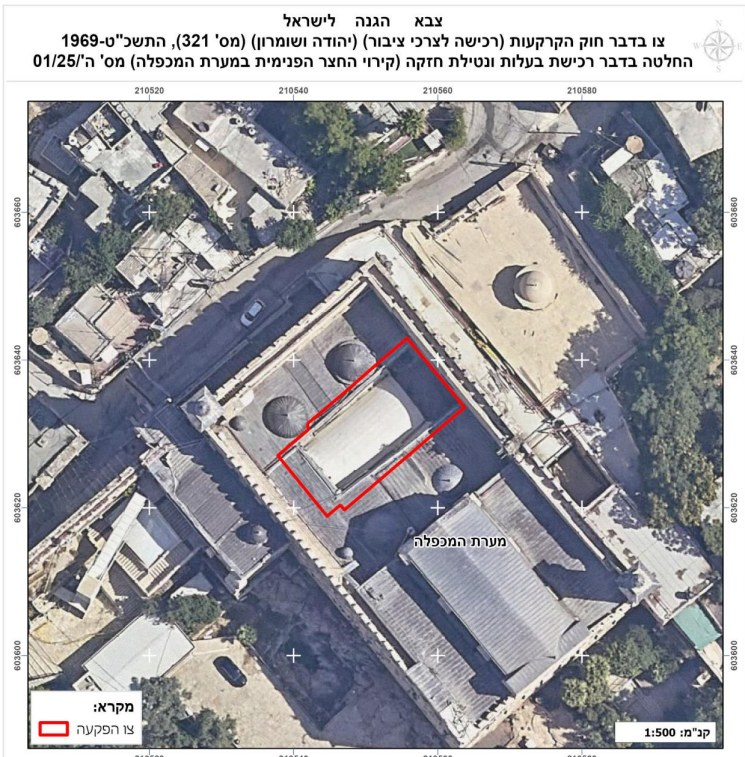
15 Sep. 2025: The Wall and Settlement Resistance Commission revealed today that the Israeli occupation authorities issued an order to seize the roof of the inner courtyard of the Ibrahimi Mosque in the city of Hebron, through an expropriation order issued today, which stipulates the confiscation of 288 square meters of the mosque’s designated roof.
The head of the Commission, Moayyad Shaaban, stated that the occupation is thereby taking a gradual and escalating course in targeting religious sites, in clear violation of all norms. He recalled, in particular, the transfer of powers over works in the Ibrahimi Mosque in February 2025 from the Palestinian Ministry of Awqaf to the so-called “Civil Planning Authority” of the occupation, followed by the July 20, 2025 decision to strip the Hebron Municipality of its supervisory authority and transfer it to the religious council of the Kiryat Arba settlement, tasked with managing parts of the mosque and implementing structural changes.
He affirmed that this decision—concurrent with the transfer of supervisory powers from the Palestinian Awqaf and the Hebron Municipality to settler entities—entrenches an approach aimed at undermining Islamic religious authority over the Ibrahimi Mosque, legitimizing direct settler intervention in managing its facilities and buildings, and isolating the mosque from its Palestinian surroundings by administratively and security-wise linking it to settler councils.
The Commission stressed that these policies clearly violate international humanitarian law and UNESCO resolutions, which recognized the Ibrahimi Mosque as a World Heritage Site under threat. These measures constitute a full-fledged settlement crime.
The Commission called on the international community—foremost UNESCO and the United Nations—to shoulder their responsibilities in protecting the Ibrahimi Mosque and preventing the occupation from imposing new Judaization measures. It further affirmed that defending the Ibrahimi Mosque is a defense of Hebron’s identity and heritage, and of the Palestinian people’s right to manage their holy sites and safeguard their religious and cultural sovereignty.