

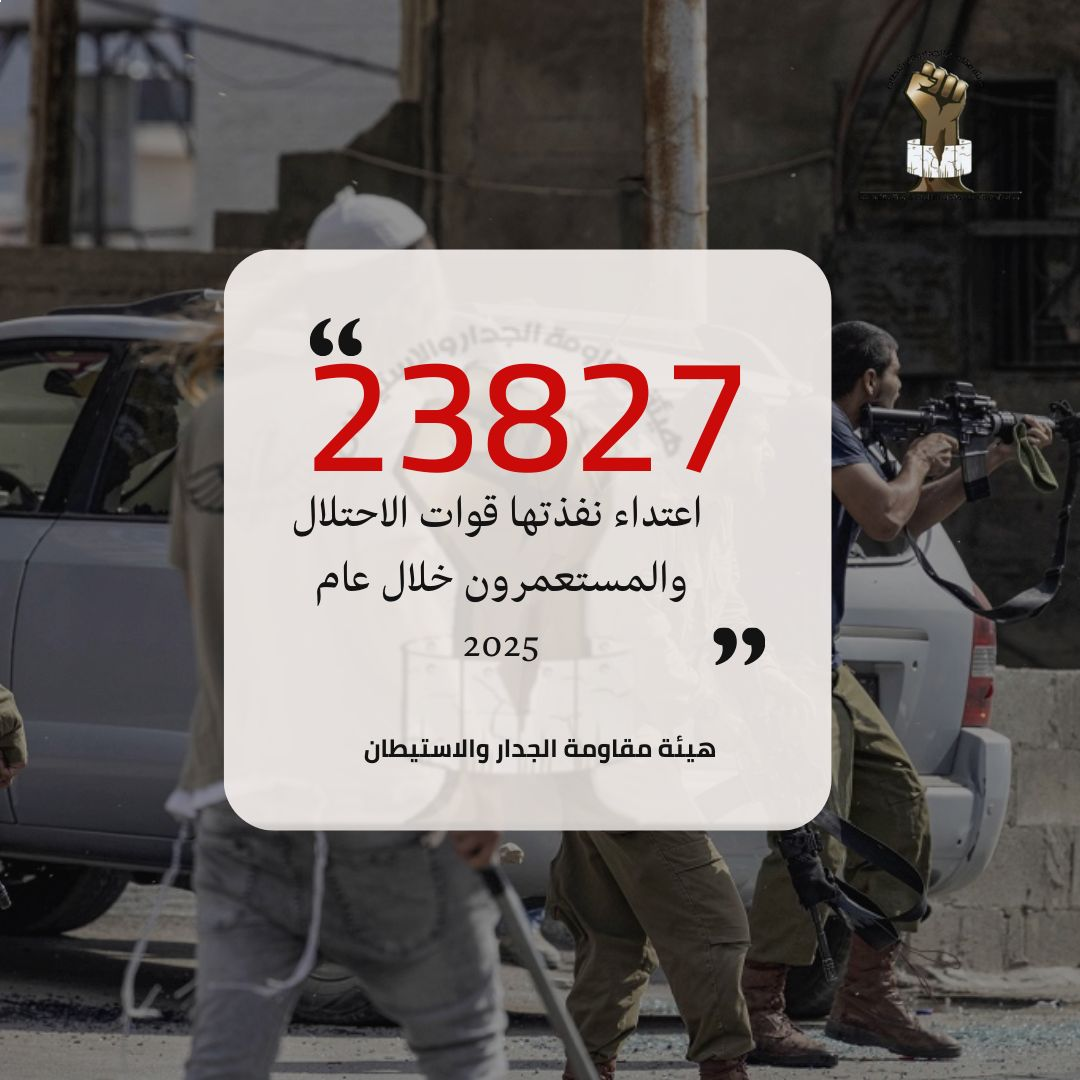
January 5, 2026: The head of the Colonization & Wall Resistance Commission (CWRC), Minister Mu'ayyad Sha'ban, reported that, in 2025, the Israeli occupation forces and colonizers committed 23,827 attacks against Palestinian citizens and their property in the governorates of the West Bank. This represents a record high for the number of attacks documented within a single year. The attacks were categorized as follows: 1,382 targeted land and trees, 16,664 attacks targeted individuals, while 5,398 attacks targeted property.
During a press conference held at the Commission's headquarters in Ramallah, Mr. Sha'ban addressed the most significant violations committed by the occupation and its colonizers in 2025. He explained that the Israeli army was responsible for 18,384 attacks, while colonizers carried out 4,723 attacks, and both parties together were involved in an additional 720 attacks.
Mr. Shaa’ban stated that 2025 was a year marked by bloodshed, territorial changes, and political resolutions. The occupying power did not simply expand colonies; it aimed to redefine the very concept of control. That is, domination is no longer limited to physical land, but rather, it extends to reshaping geography, symbolism, and the entire existence of the Palestinian people. Furthermore, the Israeli occupation authorities effectively control approximately 41% of the West Bank, maintain a tight grip on nearly 70% of Area C, and seize over 90% of the Jordan Valley through a comprehensive system of military orders and expropriation measures. These statistics are not merely neutral descriptions of reality, but they serve as tangible evidence of a fully developed political project.
Mr. Shaa’ban also declared that the annual report highlighted a year of violations that were not perpetrated in secret but rather carried out openly and politically, with the backing of a government that treats land as spoils of war, uses law as a tool, and relies on force as a substitute for legitimacy. It not only provides a numerical account of these violations but also situates them within their broader political and moral context, illustrating the outcomes of a comprehensive colonial project that targets the land, the people, and their collective memory. Thus, when Palestinian geography is reduced to isolated, besieged enclaves and Palestinians are forcibly displaced from their land, the occupation transforms into a perpetual state of existence rather than a temporary situation.
14 martyrs due to colonizers’ attacks, and 35,000 trees have been destroyed.
Mr. Shaa’ban reported that colonizers’ attacks have caused the martyrdom of 14 citizens since the beginning of 2025. He stated that colonizers have caused 434 fires affecting citizens' properties and fields, including 307 fires in residential areas and 127 fires in agricultural lands. The majority of these fires occurred in the following governorates: Ramallah witnessed 181 fires, while Nablus governorate experienced 79 fires. Meanwhile, 42 fires were in Hebron governorate, and 26 fires in Tulkarm. Additionally, he revealed that the army and colonizers carried out 892 attacks that resulted in the uprooting, damage, destruction, and poisoning of 35,273 trees, including 26,988 olive trees. The governorates most impacted by these attacks were Ramallah, Bethlehem, Nablus, Hebron, and Salfit.
Mr. Shaa’ban also stated that colonizers’ violence has led to the displacement of 13 Palestinian Bedouin communities in 2025. This has affected 197 families, including 1,090 individuals, who have been forced to leave their homes. The displaced communities are “Deir Alla”, “Ein Ayoub”, “Al-Malihat”, “Mughayir al-Deir”, “West of Kobar community”, “Al-Mahariq”, “Jibya”, and others.
He also noted that the deliberate attacks carried out by colonizers, aimed at causing destruction, resulted in 434 fires impacting Palestinian property and fields. Among these fires, 307 affected private property, while 127 targeted agricultural fields and lands. The majority of the fires occurred in Ramallah governorate which witnessed 181 fires, followed by Nablus (79 fires), Hebron (42 fires), and Tulkarm (26 fires).
1,400 facilities have been demolished, and 991 notifications of demolition have been issued:
During 2025, the Israeli occupation authorities carried out 538 demolition operations, destroying 1,400 facilities, marking an unprecedented increase in the demolition operations. This was part of a systematic effort to eliminate Palestinian construction and natural growth. The demolitions included 304 residential facilities, 74 uninhabited facilities, 270 livelihood facilities, and 490 agricultural facilities, primarily concentrated in the governorates of Hebron, Jerusalem, Ramallah, Tubas, and Nablus.
Mr. Shaa’ban also mentioned that the number of demolition notifications issued in 2025 increased to 991. These notices were primarily concentrated in Hebron (276 notices), Ramallah (169 notices), and both Bethlehem and Jerusalem (124 notices each). This pattern reveals a disturbing trend of intensified efforts to undermine Palestinian construction under the pretext of lacking permits.
The seizure of 5,572 dunams of land, and 265 master plans were proposed.
Mr. Shaa’ban reported also that in 2025, the Israeli occupation authorities seized 5,572 dunams through 94 confiscation orders for military purposes. Among these, 24 orders were issued to establish buffer zones around colonies, 52 for constructing security roads for colonizers, 5 for erecting barbed wire fences and walls, and 9 for establishing and expanding military sites. Additionally, there were 3 expropriation orders and 4 orders declaring land as “state land”. Furthermore, 16,733 dunams of previously confiscated land were allocated for colonizers ‘grazing, highlighting ongoing support for armed colonizers' terrorism under the guise of grazing and agriculture.
Regarding the colonial expansion, Mr. Shaa’ban highlighted that since the beginning of 2025, the planning committees of the Israeli occupying authorities have proposed 265 master plans aimed at establishing 34,979 colonial units on an area of 33,448 dunams. Out of these, the approval process for 20,850 units has already taken place, while 14,129 new colonial units have been deposited, in both the West Bank and neighborhoods located within the boundaries of the occupied municipality in Jerusalem.
He noted that these plans were primarily concentrated in Jerusalem Governorate, which had 107 master plans (41 plans located outside the municipality's boundaries and 66 within it). Following Jerusalem, Salfit Governorate had 41 master plans, Bethlehem had 34 master plans, Ramallah had 31 master plans, and Nablus and Qalqilia each had 17 master plans, among others.
Mr. Shaa’ban emphasized that the most concerning aspect of these plans is the approval of the E1 plan, which was approved in August of 2025 after being postponed for 30 years. He explained that this approval marks the first step of the so-called “Greater Jerusalem plan”, which seeks to annex three large colonial blocs to the municipality's area of influence. The three bloc are: the so-called “Ma'ale Adumim bloc” (which has been effectively merged), the so-called “Givat Ze'ev bloc”, and the so-called “Gush Etzion bloc”. This expansion further isolates Jerusalem from its Palestinian context and transforms it into a demographic and geographic extension of the Jewish presence that is located within the Israeli municipality’s borders.
Mr. Shaa’ban also stated that the occupying power decided to separate 13 colonial neighborhoods and designate them as distinct colonies. It also made the decision to establish 22 new colonies. By the end of the year, it further decided to establish and legalize 19 new colonial outposts, adding to a list of 68 agricultural outposts that the occupation government decided to support with all necessary infrastructure to ensure their presence on Palestinian land. Additionally, tenders were issued for the construction of 10,098 new colonial units. This includes more than 7,000 units for the so-called “Ma'ale Adumim” colony, located east of Jerusalem, 900 units for the so-called “Efrat colony” on Bethlehem land, and another 700 colonial units in the so-called “Ariel” colony, which was established on the land of Salfit Governorate.
The Israeli Knesset is a significant tool employing laws to promote colonialism:
Mr. Shaa’ban explained that 2025 marked a significant advancement on the legislative front regarding employing the legal system as a central tool to expand the colonial project. The Knesset, as the occupying power, advanced a wide range of bills and amendments aimed at legalizing existing colonies, expanding the powers of colonizers and their local councils, and promoting legal discrimination in land management, planning, and construction.
These bills included provisions intended to legalize colonial outposts established without prior government approval and to strengthen Israeli control over West Bank lands by transferring additional civil powers to occupation institutions. Furthermore, they aimed to undermine the legal status of Palestinian land and its owners. For instance, some laws enabled colonizers to own properties and land while changing the names of Palestinian territories to outdated biblical names.
Additionally, these laws sought to provide legal justification for land confiscation and demolition operations, turning exceptional measures into standard practices. This reflects the Israeli Knesset’s transformation from a traditional legislative body into a direct partner in imposing creeping annexation, redefining the Israeli occupation as a system of coerced sovereignty that relies not only on military force but also on legislation.
At the end of the press release, Mr. Shaa’ban emphasized that the current phase requires an urgent national shift from merely describing the risks to developing a comprehensive response aimed at protecting Palestinian land. This response must involve a clear division of roles and integrated efforts among official institutions, political forces, and civil society. He stressed the need for immediate and systematic protection of targeted Palestinian communities through practical and sustainable intervention plans that strengthen the resilience of Palestinians on their land, recognizing them as rightful owners rather than mere recipients of aid.
Additionally, Mr. Shaa’ban added that this effort should coincide with the unification of Palestinian legal initiatives and the activation of international accountability mechanisms without delay or selectivity. Leveraging the extensive documentation available can enhance legal proceedings before international courts and relevant UN bodies. Shaa’ban also called for the development of popular resistance tools to ensure their ongoing effectiveness, transforming them from seasonal and symbolic acts into organized and impactful actions. At the same time, he emphasized the importance of creating a unified national political and media discourse that redefines the current situation as a fully-fledged colonial project. He concluded that all these efforts should fall within a comprehensive national vision for protecting Palestinian geography, where the supreme national interest takes precedence. This vision should be based on a conscious popular will capable of turning steadfastness into action and establishing the right as an irreversible path to restoration.