

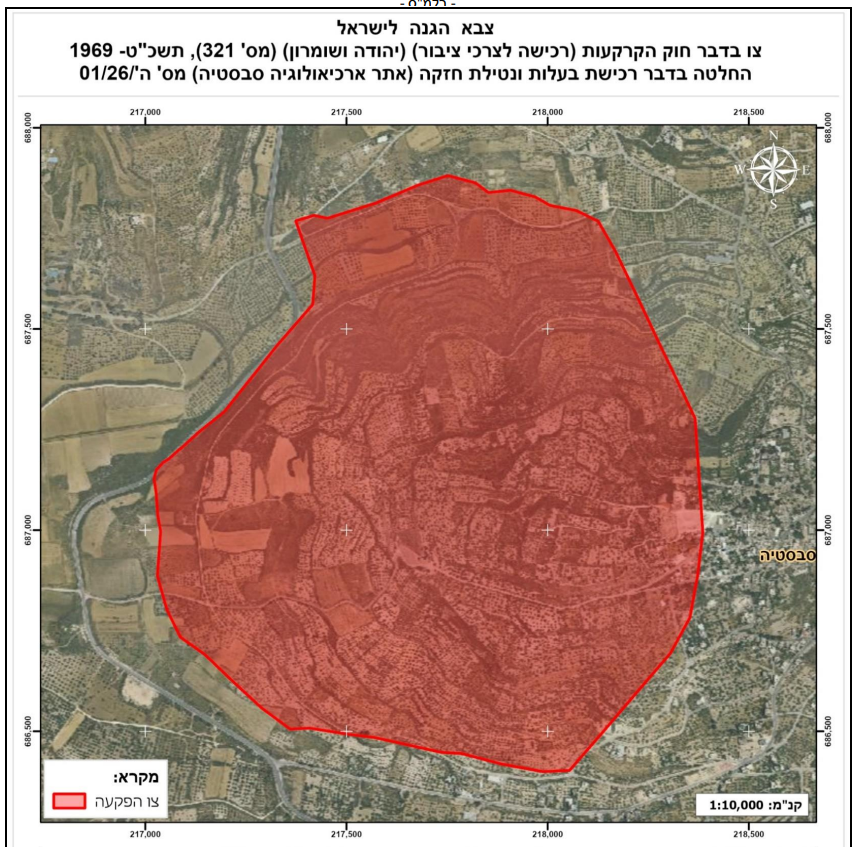
February 17, 2026: Head of the Colonization and Wall Resistance Commission, Minister Mu'ayyad Sha'ban, stated that the occupation today issued an order to confiscate 2,000 dunums of land from the towns of Sebastia and Burqa, north of Nablus Governorate, according to an expropriation order targeting the archaeological site in the area. Mr. Sha'ban explained that the official expropriation order issued today constitutes a direct continuation of the declaration of intention to confiscate previously issued under Order No. (2/25) dated January 18, 2025, with which the occupation state sufficed at the time to announce the intention to confiscate without further clarifications.
Mr. Sha'ban said that the issuance of an expropriation order by the occupation authorities for the archaeological site in Sebastia reveals a selective exploitation of legal tools to achieve colonial goals and constitutes an assault on the cultural and civilizational heritage of the Palestinian people. The concept of expropriation in international law is intended to allocate land for public benefit serving the population under administration equally and non-discriminatorily. However, the current practice exploits this procedure to entrench effective control over the land and allocate it exclusively for the service of colonizers, transforming a tool meant to serve the public good into a means of redistributing benefit on a colonial basis, serving the colonizers and acting as a sword hanging over the necks of the landowners. This strips the procedure of its legal legitimacy and reveals its nature as a mechanism for disguised annexation under an administrative cover.
Mr. Sha'ban clarified that the area previously announced by the Colonization and Wall Resistance Commission regarding the targeted site, amounting to 1,473 dunums, was an estimate based on spatial approach, given that the declaration of intention to confiscate at the time did not include a precise determination of the areas but rather indicated general boundaries without detailed disclosure of the plans or final measurements. Accordingly, the order issued today, which carries the number (26/1), does not represent a separate new procedure but reveals the actual size of the land targeted within the same process.
Mr. Sha'ban added that the transition from declaring an intention to confiscate to issuing a formal expropriation order, accompanied by a statement of the exact area, confirms that what happened over the past months was a preparatory phase within a gradual procedure that appears legal on the surface, aimed at consolidating legal and administrative control over the archaeological site and its geographical surroundings. Furthermore, the area targeted for confiscation, which reached 2,000 dunums, clarifies that the targeting is not limited to the boundaries of the archaeological site but extends to include the surrounding spatial area, with its implications for agricultural lands and the expansions of the towns of Sebastia and Burqa.
Mr. Sha'ban affirmed that the occupation state, by exploiting the antiquities file to infiltrate Palestinian land, confirms the broader policies aimed at imposing facts of de facto annexation in the occupied West Bank, through legal and administrative tools that appear on the surface to be regulatory or heritage-related, while in essence performing a function intended to re-engineer control over the land.
He also stressed that today's revelation of the actual targeted area multiplies the gravity of the procedure and necessitates urgent legal action to confront the expropriation order, in addition to diplomatic and legal advocacy to expose the use of cultural heritage as an entry point to expand control over Palestinian land.
He added that protecting archaeological sites will remain an integral part of protecting the land and national identity, and that any attempt to transform heritage into a tool for control or annexation will be confronted with all available legal and national means.