

Ramallah, 3 March, 2025: The head of the Colonization & Wall Resistance Commission, Minister Mu’ayyad Sha’ban, stated that the occupation forces and the colonizers perpetrated a total of 1965 attacks during past February. These attacks are a part of an ongoing series of the occupying state’s terror against the Palestinian people, their land, and their property.
Mr. Sha’ban explained in the commission’s monthly report titled “The Israeli Occupation Violations and Colonial Expansion Measures” that the occupation army committed a total of 1454 attacks, while the colonizers committed 511 attacks. Most of the attacks were concentrated in the Hebron Governorate, with 421 attacks, followed by the Nablus Governorate, with 340 attacks, then Ramallah and Al-Bireh, with 320 attacks, and Jerusalem, with 210 attacks.
Mr. Sha’ban clarified that the attacks varied between direct physical assault, tree-uprooting, field burning, property confiscating, and house and agricultural facilities demolishing, in a time when the occupying forces closes vast areas of Palestinian land under the pretext of “security reasons” while colonizers are enabled to thrive in said areas.
He added that these escalating violations confirm that what is happening are not merely isolated incidents; rather, they are a part of an organized methodology that aims to empty the land of its owners and impose a racist colonial system.
A Wave of Terrorist Colonizer Attacks and the Uprooting of 1314 Trees
Mr. Sha’ban pointed out that colonizer attacks, which reached a total of 511 incidents in the past month, constitutes a new peak of colonizer terrorism that target Palestinian villages and Bedouin communities. The attacks were concentrated in the Hebron Governorate, with 138 attacks, followed by the Nablus Governorate, with 121 attacks, and the Ramallah Governorate, with 98 attacks.
Mr. Sha’ban also clarified that the February numbers showcase a dangerous phase of organized escalations; the colonizers attacks are no longer irregular incidents or isolated reactions, rather, they transformed into a field policy that targets the land, the people, and the Palestinian means of existence. He added that what we are witnessing today is a systematic attempt to reshape the Palestinian geography by force through targeting sources of livelihood, terrorising Bedouin communities, and creating a hostile environment that drives people to forced displacement under the pressure of daily violence.
He affirmed that we are still facing a clear pattern of coordinated actions carried out under the protection of the occupation army, revealing the integration of roles between the official institutions of the occupation and colonizer militias. In their broader context, these actions send clear and unambiguous political messages aimed at imposing permanent facts on the ground and thwarting any possibility of establishing a geographically contiguous Palestinian state.
He added that colonizers carried out 355 operations of vandalism and theft of Palestinian property, affecting vast areas of land. Furthermore, colonizer attacks, with the assistance of the occupation army, resulted in the uprooting, vandalism, and poisoning of 1,314 trees, including 1,054 olive trees, across several governorates: Ramallah with 731 trees, Bethlehem with 200 trees, Hebron with 183 trees, Nablus with 180 trees, and Tulkarm with 20 trees.
Attempt to Establish 5 New Colonial Outposts
Mr. Sha’ban pointed out that colonizers attempted to establish 5 new colonial outposts since the beginning of last February, predominantly agricultural and pastoral in nature. These outposts were distributed as attempts to establish two outposts in both Hebron and Nablus, and one outpost in Tubas. Mr. Sha'ban also affirmed that the escalation in attempts to establish colonial outposts recently could only happen with clear instructions from the political level in the occupying state, aiming to impose facts on the ground and further fragment the Palestinian geography. Colonizers undertake the task of effecting change on the ground, and then the official level converts this change into a fait accompli by legalizing it, consolidating it, and transforming it into a colonial site that receives all services.
The Seizure of 2,022 Dunums of Citizens' Land
Mr. Sha'ban stated that the occupation authorities last February seized 2,022 dunums of citizens' land through a series of military orders for seizure and confiscation. He explained that the occupation authorities issued a total of 8 military seizure orders for military purposes, through which they seized an area of 21.5 dunums. Mr. Sha'ban added that the occupation authorities solidified the procedures for confiscating the Sebastia archaeological site through a military confiscation order bearing number 26/1, ordering the confiscation of a total of 2,000.068 dunums of the archaeological site, in the largest archaeological seizure operation witnessed in the Palestinian territories.
Demolition of 122 Facilities and Notifications for the Demolition of 49 Others
Mr. Sha’ban pointed out that the occupation authorities carried out 72 demolition operations during February, affecting 122 facilities. These included 56 inhabited homes, 9 uninhabited homes, 34 agricultural facilities, and 18 livelihood sources. The demolitions were concentrated in the Jerusalem governorate with 46 facilities, Hebron governorate with 38 facilities, followed by Tubas governorate with the demolition of 9 facilities, Jenin with 8 facilities, and others. Mr. Sha'ban explained that the occupation authorities distributed 49 notifications for the demolition of Palestinian facilities, continuing the series of restrictions on Palestinian construction and the natural growth of Palestinian villages and towns, which is currently translating into a high intensity of demolition operations. The notifications were concentrated in Bethlehem governorate with 22 notifications, 10 notifications in Hebron, 8 notifications in Jerusalem, 3 in Tulkarm, 2 each in Tubas and Salfit, and one notification in both Jenin and Ramallah.
22 Master Plans for Colonies Studied
Mr. Sha'ban added that the planning authorities in the occupying state studied a total of 22 master plans during February for the West Bank colonies and colonies within the boundaries of the occupation municipality in Jerusalem. This included 13 master plans for West Bank colonies and 4 plans for colonies within the boundaries of the occupation municipality in Jerusalem.
He added that these authorities approved 7 master plans for West Bank colonies and deposited 5 other plans for subsequent approval. Through these, they deposited 48 units and approved the construction of 642 new colonial units on an estimated area of 1,154.5 dunums.
Meanwhile, the Jerusalem municipality approved 3 master plans for Jerusalem colonies and deposited 6 other plans for subsequent approval concerning colonies within the boundaries of the occupation municipality in Jerusalem, totaling 613 colonial units on an estimated area of 316.45 dunums of citizens' land.
Mr. Sha'ban explained that the maps attached to the master plans indicate the occupation's approval for the establishment of a large colonial neighborhood belonging to the Asfar/Metsad colony, built on citizens' land in Ash-Shuyukh in Hebron governorate. This came through the approval of master plan number יוש/3/2/414, which aims to build 509 new colonial units on an area of 342 dunums of citizens' land.
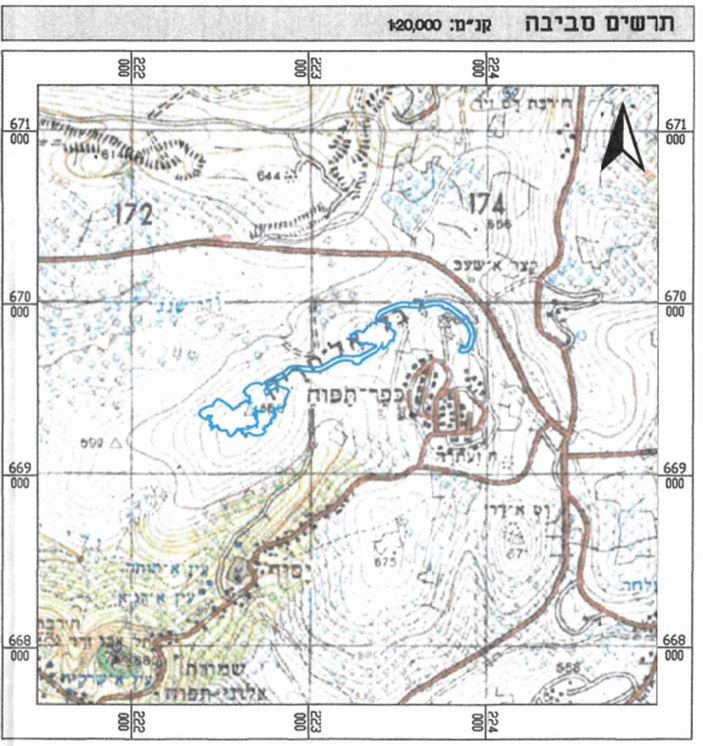 The maps attached to the master plans (see side map) also showed the occupation's approval for the establishment of a colonial neighborhood belonging to the Kfar Nefouh colony, built on citizens' land in Yasouf village in Salfit governorate. This came through the approval of master plan number יוש/1/3/131, which aims to build 133 new colonial units on an area of 118 dunums of citizens' land.