

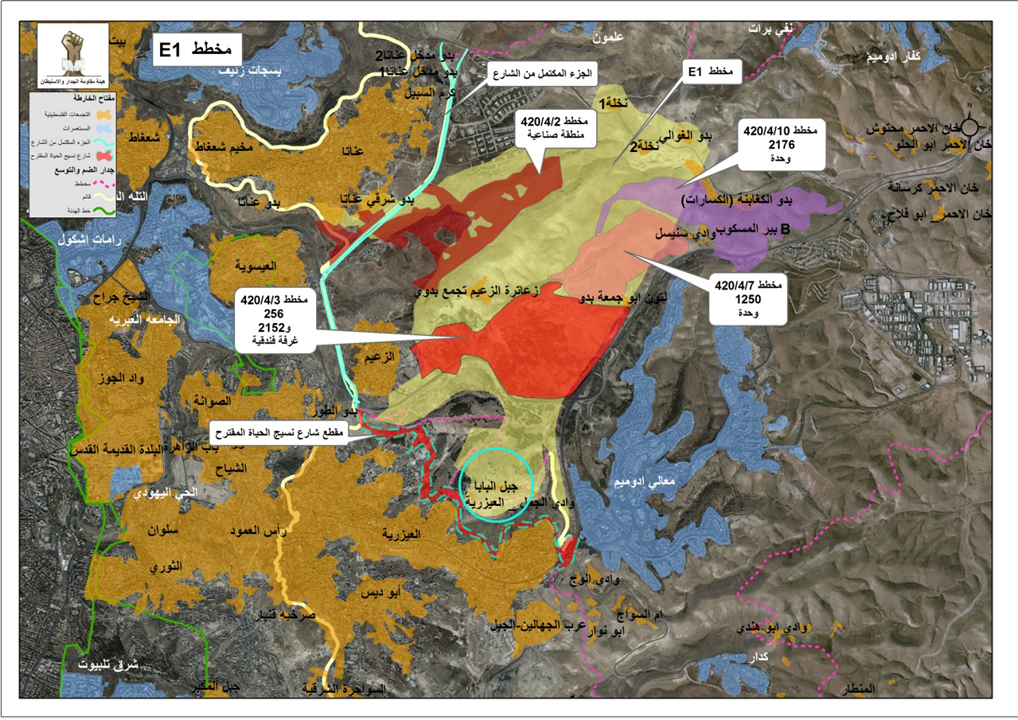
January 7, 2025: Minister Mu’ayyad Sha’ban, Head of the Colonization and Wall Resistance Commission, stated that Israeli occupation authorities, represented by the so-called "Israel Land Authority", have issued a major tender for the construction of 3,401 colonial units in the E1 area, east of occupied Jerusalem. Mr. Sha’ban highlighted this move as a gravely dangerous development, signaling a rapid acceleration of assaults on Palestinian land through settler-colonial schemes.
Mr. Sha’ban emphasized that this marks the occupation authorities' operational transition from the planning and approval stage to the execution phase regarding one of the most dangerous colonial projects, which had been nominally frozen for three decades.
He explained that this tender follows the plan’s approval in August 2025, after being stalled for nearly 30 years due to international pressure. He noted that initiating these tenders effectively means severing Jerusalem from its Palestinian periphery entirely and linking the Ma'ale Adumim colony to the city under the "Greater Jerusalem" project. This, he warned, undermines any realistic possibility of establishing a geographically contiguous Palestinian state.
Mr. Sha’ban added that the year 2025 witnessed an unprecedented escalation in colonial tenders, with occupation authorities issuing tenders for a total of 10,098 new units. The lion’s share was allocated to the Ma'ale Adumim colony, which were estimated at over 7,000 units, while 900 units were designated for the Efrat colony on Bethlehem lands, and 700 units were designated for the Ariel colony on Salfit lands. These figures, he noted, reflect a systematic drive to deepen colonial control over Palestinian territory.
Mr. Sha’ban also asserted that these tenders cannot be viewed in isolation from the occupation government's broader political context. He argued the government is forging ahead to impose permanent colonial facts on the ground using planning, construction, and legislative tools, transforming colonial activity from a creeping policy into declared, de facto annexation implemented under legal and administrative cover.
Warning that the developments in E1 represent a critical turning point in the Israeli colonial landscape, Mr. Sha’ban called on the international community to move beyond mere verbal expressions of concern. He urged the adoption of practical measures to halt the occupation’s actions, which constitute a flagrant violation of international law and resolutions, and directly undermine the prospects for peace and regional stability.
Mr. Sha’ban concluded by affirming that the Colonization and Wall Resistance Commission will continue to pursue this file at all national and international levels, committed to exposing its political and geographic repercussions as one of the most critical pivots of the Israeli colonial project in and around Jerusalem.