

Ramallah, July 6, 2026: The head of the Colonization & Wall Resistance Commission (CWRC), Mu’ayyad Shaa’ban, declared that the total number of attacks carried out by the Israeli occupying state in the first half of 2026 was 11,074. These attacks involved various branches of the occupying state, including colonial militias. Mr. Sha'ban highlighted that this significant escalation in the nature, number, and form of the attacks coincided with the horrifying aggression launched by the Israeli occupying state against our people in the Gaza Strip and throughout all areas of Palestinian presence.
He detailed that the attacks included a range of actions, such as land confiscation, colonial expansion, forced displacement, field execution, demolitions and bulldozing of land, uprooting of trees, property confiscation, as well as closures and checkpoints that disrupt the connections within Palestinian geography. The majority of these attacks were concentrated in Hebron Governorate which witnessed 2,224 attacks, followed by Ramallah and Al-Bireh Governorate where 2,175 attacks were recorded. Meanwhile, 2,095 attacks were recorded in Nablus Governorate and 1,137 attacks in Bethlehem Governorate. Mr. Sha'ban also stated that the Israeli occupying state has changed its approach to colonies. Instead of viewing them just as tools for gaining more Palestinian land, it now uses them as a way to reshape Palestinian territory politically, legally, and administratively. This shift is making the annexation project a permanent reality.
He explained that during the first six months of 2026, there was a significant change in how the colonial project operated. The Israeli government moved quickly to pass new laws and make decisions that placed colonies at the center of its public policies. This change included expanding plans for colonies, establishing new colonial outposts, confiscating land, redrawing colonial boundaries, establishing buffer zones around these colonies, and increasing demolition orders. At the same time, there was a rise in organized violence by colonizers against Palestinian people and their property.
Mr. Sha'ban warned that this phase is dangerous not just because of the growing number of colonial units or outposts. The Israeli occupying government is working to reshape Palestinian geography by combining laws, planning, military, and security actions into one government policy. This policy aims to weaken the Palestinian presence and prohibits any chance of urban, economic, or demographic growth for Palestinians. Meanwhile, the Israeli government is creating a supportive legal and financial environment to expand and sustain the colonial project.
Mr. Sha’ban emphasized that the current situation represents a shift from managing occupation to managing annexation. The measures associated with occupation are no longer viewed as temporary actions by an occupying power; instead, they have become sovereign practices aimed at gradually subjecting Palestinian land to the Israeli legal and administrative system. This approach establishes facts on the ground that will be difficult to reverse in the future. He pointed out that this trend is accompanied by intensified efforts to redistribute Palestinian geography, isolate Palestinian population centers from one another, and tighten control over natural resources, road networks, and strategic routes. This strategy aligns with the Israeli vision of asserting sovereignty over large parts of the West Bank, ultimately undermining the geographical and political foundations necessary for the establishment of an independent, contiguous, and viable Palestinian state.
After 1000 days on the war of genocide, the Israeli occupying army and colonizers have carried out 56,235 attacks. These attacks target Palestinian lands, properties, and lives.
3488 Attacks by Colonizers:
Mr. Sha’ban reported that during the reporting period, there were 3,488 attacks carried out by colonizers. These attacks included storming Palestinian villages, assaults on residents, setting fire to homes with occupants inside, shooting at civilians, establishing colonial outposts, seizing Palestinian land, and launching organized attacks. The consequences of these actions have been severe, resulting in the martyrdom of 17 Palestinians by colonizers. This includes 9 in Ramallah Governorate, 3 in Nablus, 2 each in Jerusalem and Hebron, and 1 in Salfit.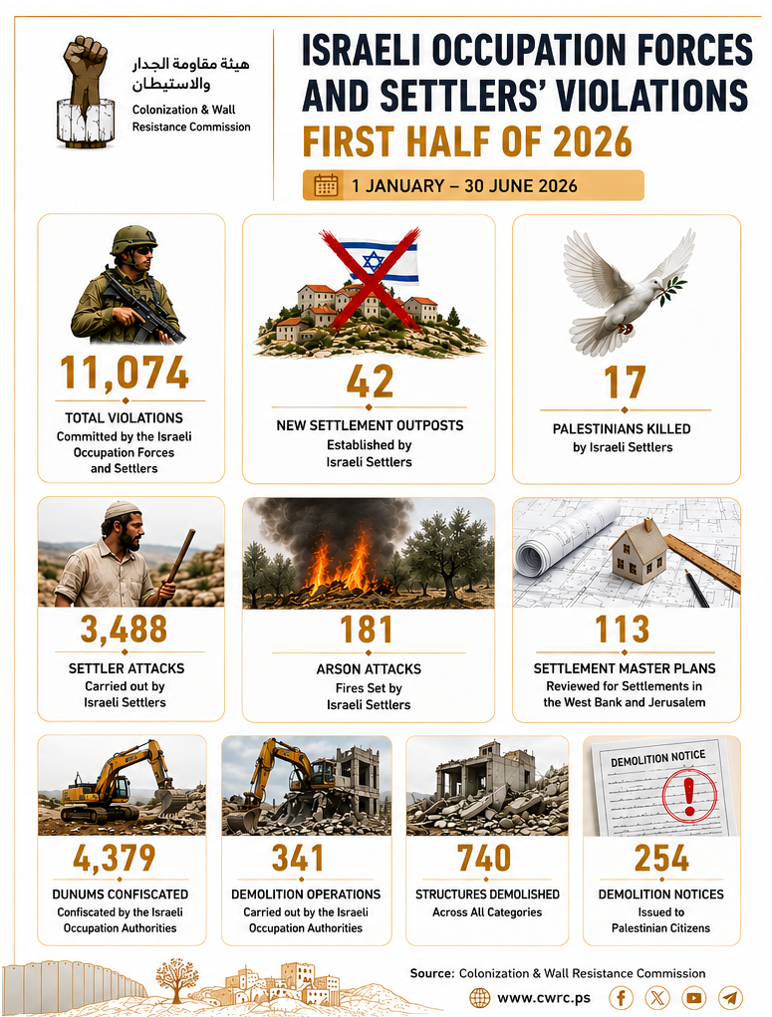
Additionally, these attacks have caused significant damage to 26 Bedouin communities, leading to the partial displacement of 8 communities and the complete displacement of 18 others since the beginning of the year. Most of the colonizers attacks were concentrated in Nablus Governorate (900 attacks), Hebron Governorate (840 attacks), and Ramallah and Al-Bireh Governorate (780 attacks), among others.
In the first half of 2026, colonizers established 42 outposts on Palestinians’ private lands, with the majority being agricultural outposts. Among these, four were set up in Area B, as defined by the Oslo Accords. The distribution of the outposts included 13 in Hebron Governorate, 9 in Ramallah Governorate, 8 in Nablus Governorate, 4 in Bethlehem Governorate, and others in various areas. This activity reflects the colonizers' ongoing policy of creating facts on the ground, which is fully supported by the Israeli army.
Mr. Sha’ban also reported that Israeli occupation authorities and colonizers’ militias have uprooted or damaged 45,195 trees, including 26,395 olive trees. Specifically, of these, 16,617 were in Hebron Governorate, 7,783 in Jenin Governorate, 6,834 in Ramallah Governorate, and 6,015 in Nablus Governorate, among others. This marks a record number of trees uprooted, indicating a clear and systematic effort to empty and destroy Palestinian land.
After 1000 days on the war of genocide, the colonizers have carried out 12,506 attacks. These attacks have resulted in the martyrdom of 52 Palestinian citizens. The colonizers have also set fire to 890 properties and fields owned by Palestinian citizens.
Approving 113 master plans for the colonies and legalizing 34 new colonies
Mr. Sha’ban explained that from the beginning of 2026 until the end of June, the Israeli occupation authorities reviewed (deposited and approved) 113 master plans for expanding colonies or establishing new ones. Of these, 71 master plans were for colonies in the West Bank, and 42 for colonies in Jerusalem. These master plans included more than 8,434 residential units in West Bank colonies and 4,001 in Jerusalem colonies, covering an area of 14,215 dunams of Palestinian land.
The Israeli occupation authorities also approved the construction of 5,859 colonial units in West Bank colonies and 2,104 units within the boundaries of the Israeli-controlled Jerusalem municipality. Mr. Sha’ban added that these plans coincided with the occupation government's approval of 34 new colonies during the first half of the year, bringing the total number of colonies approved by the current government since its formation to 103. Of these, more than 39 will be built from scratch, indicating a clear shift in the colonial expansion policy from expanding existing colonies to creating new ones.
After 1000 days on the war of genocide, the Israeli Planning authorities in the occupying state reviewed 524 master plans for expanding colonies.
During this period, the Israeli government confiscated more than 4,379 dunams of Palestinian land under various pretexts. The Israeli occupation authorities issued 40 military seizure orders, resulting in the confiscation of 611 dunams. These confiscations contributed to the establishment of four buffer zones around colonies, 16 security roads, 12 military sites, and additional facilities. Furthermore, five expropriation orders were issued, causing the confiscation of 2,604 dunams, while four state land declarations led to the seizure of 1,163 dunams. Mr. Sha’ban noted that the Israeli occupying state intensified its targeting of Palestinian trees by issuing 48 military orders under the pretext of security measures. These orders affected trees and crops across an area of 2,093 dunams. This move signifies a transformation in the colonial map of the West Bank, which serves the colonial annexation project and the imposition of Israeli sovereignty over Palestinian land.
After 1000 days on the war of genocide, the Israeli occupying authorities seized 60,000 dunams of Palestinian land. They confiscated 20,000 dunams by claiming it was for amending the boundaries of nature reserves. They also declared 28,000 dunams as state land in the areas of Jerusalem, Nablus, Ramallah, Bethlehem, Qalqilia, and Salfit. Additionally, they confiscated 3,400 dunams through 171 orders for military and security reasons.
740 facilities were demolished and 254 more received demolition notices
Mr. Sha’ban reported that, to limit Palestinian construction and growth in their villages and towns, the Israeli occupation authorities demolished 740 facilities in the first half of 2026. This happened during 341 demolition operations, affecting 923 people, including 546 children and 431 women. Additionally, the Israeli occupation authorities issued 254 demolition notices for Palestinian buildings, claiming they lacked permits. Most of these notices were in Hebron Governorate (102 notices), Bethlehem Governorate (70 notices), and Jerusalem Governorate (34 notices).
After 1000 days on the war of genocide, the Israeli occupying authorities have carried out 1,492 demolitions, targeting 4,587 facilities of various types, and have issued 2,043 demolition orders for Palestinian buildings.
Mr. Sha’ban emphasized that data from the first half of 2026 indicates the colonial project has progressed beyond urban expansion and field attacks. It has entered a more serious phase characterized by reshaping Palestinian geography through an integrated system of legislation, government decisions, military orders, colonial planning, and organized violence perpetrated by the Israeli occupying power and its settler militias. He stated that these policies represent the practical implementation of a creeping annexation project, imposing Israeli sovereignty over Palestinian land in flagrant violation of international law and resolutions of international legitimacy. He called on the international community to move beyond mere verbal condemnation and to take practical measures that ensure accountability for the occupying power, halt its crimes, and provide international protection for the Palestinian people. Mr. Sha’ban also warned that continued impunity is the primary factor fueling the escalation of colonial activity and the increasing violations against Palestinian land and people