

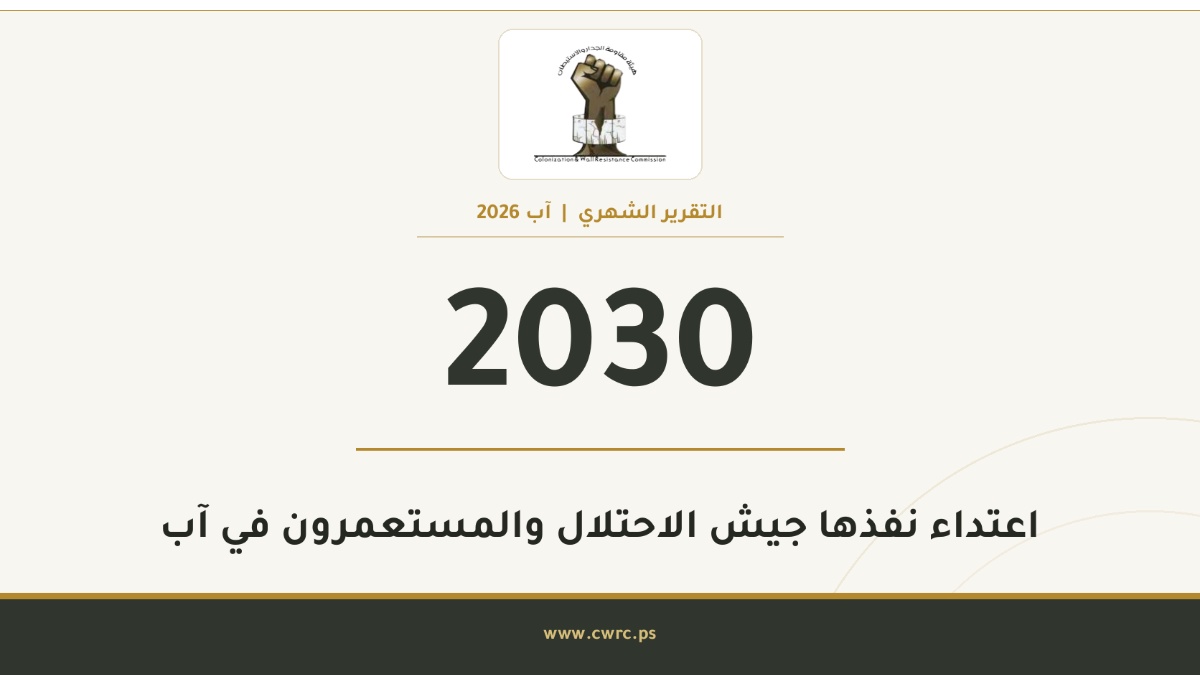
September, 1, 2026, The Colonization & Wall Resistance Commission (CWRC), issued a press release stating that Israeli occupation forces and colonizers perpetrated 2,030 attacks against Palestinian citizens, their lands, and properties during August 2026. This demonstrates the ongoing colonial violence that systematically targets the Palestinian presence and undermines their ability to remain on their land. The Commission detailed the distribution of these attacks, indicating that the Israeli army carried out 1,402 attacks, while colonizers perpetrated 628 attacks.
The Commission reported that the majority of attacks were concentrated in Nablus Governorate, which experienced 380 attacks. The Ramallah and al-Bireh Governorate followed this with 353 attacks, Hebron with 275, Bethlehem with 239, Jenin with 230, and Jerusalem with 194. This pattern indicates that attacks are primarily occurring in areas where colonial expansion is intensifying and efforts to control roads, transportation, and agricultural and grazing lands are escalating.
The Commission explained that the severity of these attacks is heightened by their interconnected nature, all aimed at undermining the Palestinians' ability to remain on their land. Israeli procedures such as direct violence, gunfire, uprooting trees, burning fields, preventing access to land, stealing property, and demolishing homes and agricultural facilities are all part of a coordinated effort that affects personal security, livelihoods, housing rights, and the ability to cultivate land. These actions turn daily life into a series of risks and costs that force citizens to leave.
Furthermore, these attacks coincide with the closure of significant Palestinian areas, which have been designated as military or security zones. This situation reveals a paradox: while Palestinians are restricted from accessing and utilizing their land, colonizers receive protection, have access to roads, and benefit from resources necessary for expansion. Consequently, the security rationale becomes a tool for displacing Palestinians and redistributing rights of access, use, and control in favor of the colonial project.
A persistent rise in colonial terrorism:
The Commission reported that colonizers carried out 628 attacks throughout the month, primarily concentrated in the following areas: Ramallah and al-Bireh Governorate (157 attacks), Nablus (137 attacks), Hebron (120 attacks), Bethlehem (73 attacks), Tubas (40 attacks), Jenin (36 attacks), and Jerusalem (31 attacks).
The commission also noted that colonizers’ violence resulted in the martyrdom of 17-year-old Karim Sand Shalalda on August 21, 2026, who was shot during an attack in the Hamroush area of Sa'ir, located in Hebron Governorate. This incident raised the total number of Palestinians killed by colonizers since the beginning of 2026 to 25.
The Commission also highlighted that colonizers attacks directly affected 164 Palestinians, including 20 children and 17 women. The highest number of affected individuals was reported in Hebron Governorate (68), followed by Nablus (50) and Ramallah and al-Bireh (23).
Furthermore, the Commission indicated that attacks on trees and crops in August targeted 21,508 trees, of which 19,375 were olive trees. The affected trees were distributed as follows: 4,892 in Salfit, 4,241 in Jenin, 3,718 in Nablus, 3,530 in Qalqilia, 2,311 in Hebron, 1,652 in Ramallah and al-Bireh, 802 in Tubas, and 362 in Bethlehem.
Efforts to Establish 32 colonial Outposts
In August 2026, there were attempts to establish 32 new colonial outposts, according to the Commission. These attempts were mainly concentrated in the following areas: 9 in Ramallah and al-Bireh Governorate, 6 in both Hebron and Nablus Governorates, 3 in Jenin, and 2 each in Jerusalem, Bethlehem, and Tubas. Additionally, there was 1 attempt each in Tulkarm and Qalqilia.
The Commission noted that the establishment of these outposts represents the initial stage in the process of land control. This process begins with erecting tents and facilities, paving roads, and imposing military protection. It then progresses to strengthening the outpost by providing it with services and infrastructure and connecting it to existing settlements. The ultimate goal is to attempt to legalize the outpost's status, transforming it into a colony recognized by the Israeli occupying government.
The Commission stressed that this pattern primarily targets rural and agricultural areas, as well as lands located between Palestinian villages. The objective is to control vast areas with minimal facilities and colonizers, thereby creating contiguous colonial territory while fragmenting and isolating Palestinian communities.
Seizure of approximately 1,629 Dunums of Palestinian Land
The Commission stated that the occupation authorities confiscated 1,629 dunums of Palestinian land through a series of military orders, most notably state land declarations targeting 1,152 dunums of land belonging to Sinjil, Al-Libban Ash-Sharqiya, and Qaryut, and 370.28 dunums of land belonging to Abu Dis and 'Arab As-Sawahira, bringing the total area of direct confiscation under the designation of "state land" during the month to 1,628.5 dunums. It is worth noting that the latest declaration threatens the geographic space of the al-Muntar Bedouin community.
The occupation authorities also issued 9 seizure orders during the month of August, targeting more than 106 dunums, most notably 37.481 dunums of land belonging to Bitunia, 19.30 dunums of land belonging to Tubas, 15.580 dunums of land belonging to Al-Jib, 15.342 dunums of land belonging to Al-Bireh, and 11.970 dunums of land belonging to Jaba', in addition to areas in Marka, Marda, Jinsafut, and Jericho.
The Commission added that the occupation authorities issued 8 further orders under the designation "adoption of security measures," affecting 317.086 dunums and authorizing the removal of wild vegetation and the uprooting of olive trees, 310.868 dunums of which were in Jenin governorate alone. This area is not included within the total of direct confiscation, but it represents an effective restriction on land use and an alteration of its vegetative cover, bringing the total area targeted by seizure orders, "state land" declarations, and security-measures orders during August to 1,945.597 dunums.
Demolition of 155 Facilities and Issuance of 44 Notifications
The Commission stated that the occupation authorities carried out 71 demolitions during August, affecting 155 facilities, distributed among 47 inhabited residences, 8 uninhabited residences, 33 facilities constituting sources of livelihood, 61 agricultural facilities, and 6 other facilities.
The Commission noted that the highest demolition toll was recorded in Jenin governorate, with 29 facilities demolished, followed by Jericho and Hebron with 24 facilities each, then Nablus with 21 facilities, Ramallah and Al-Bireh with 16 facilities, Jerusalem with 15 facilities, Bethlehem with 13 facilities, Tubas with 9 facilities, Tulkarm with 3 facilities, and Qalqilya with a single facility.
The Commission added that the occupation authorities issued 44 notifications during the month targeting Palestinian facilities and properties, concentrated in Hebron with 11 notifications, Jerusalem and Bethlehem with 8 notifications each, and Jenin and Tulkarm with 5 notifications each.
The Commission indicated that the demolition operations directly harmed no fewer than 200 documented citizens, including 75 children and 56 women, confirming that the demolition policy does not target buildings alone, but strikes at family stability and sources of livelihood, driving Palestinian families into a coercive environment in which remaining becomes increasingly difficult.
12 Colonial Plans proposed:
The Commission stated that the occupation authorities advanced 12 colonial plans and projects in the West Bank and Jerusalem during August, distributed among 6 plans deposited, 4 plans approved, and 2 construction tenders. These measures encompassed 3,819 colonial units, while the area of the deposited and approved plans totaled 5,472.22 dunums.
It indicated that the West Bank accounted for 9 plans: 4 deposited plans comprising 912 units over an area of 476.618 dunums in the colonies of "Avigal," "Hananit," "Psagot," and "Giv'at Ze'ev"; and 3 approved plans comprising 156 units over an area of 4,871.402 dunums, most notably the widening of Route 60 between the Tapuah Junction and the British Police Junction, spanning 18 km over an area of 4,693 dunums. The occupation authorities also issued two tenders for the construction of 1,861 units, 627 units in "Kochav Ya'akov" and 1,234 units in the E1 area, advancing the E1 project into the implementation phase, intending to link "Ma'ale Adumim" to Jerusalem and sever Palestinian geographic contiguity between the north, center, and south of the West Bank.
In occupied Jerusalem, the occupation authorities announced 3 colonial plans, two of which were deposited and comprise 890 units over an area of 30.176 dunums, 650 units in the new colony "Nof Rachel" at the western entrance to Sur Baher, and 240 units in "Gilo", alongside the approval of an infrastructure plan south of "Gilo" covering 94.024 dunums. The Commission affirmed that the convergence of these unit plans with road and infrastructure projects and the E1 tender reveals an integrated trajectory for reshaping Palestinian geography, linking colonial blocs together while fragmenting and isolating Palestinian communities.