


August 12, 2025: The Colonization & Wall Resistance Commission exposed the systematic transformation of a group of large colonial outposts around the colony of Eli, which was established on stolen citizens’ lands in the villages of As-Sayiah, Al-Libban, and Qaryout, into large colonial neighbourhoods affiliated with the colony. The head of the commission, Minister Mu’ayyad Sha’ban, stated that the occupying state has recently approved several large master plans that aim to create huge expansions to the colony of Eli. This plan is put forward to execute other plans that aim to separate the central occupied West Bank from its north. This separation is possible through the colonial bloc extending between the colonies of Shilo and Eli, in addition to the colonial outposts surrounding them in the area between the governorates of Rammalh and Nablus.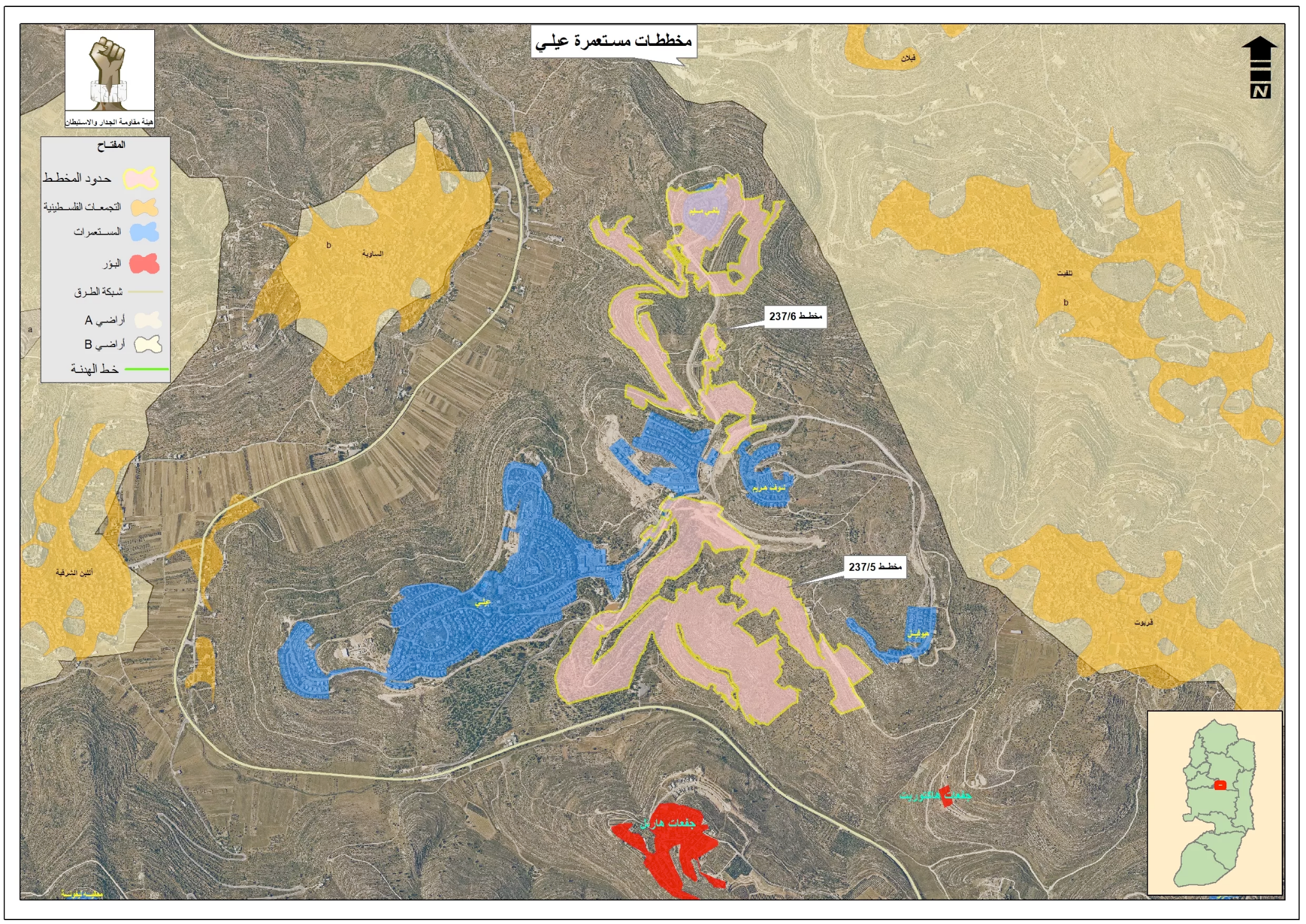
Mr. Sha’ban explained that in July of last year, the occupying state deposited a master plan for the colony, numbered יוש/7/237, which aims to construct 50 new colonial units across 8.6 dunums of land. This plan targets fragmented parcels within the existing colony's territory. Furthermore, in recent days, the occupation authorities approved two major expansion plans: the first, numbered יוש/5/237, encompassing approximately 638 dunums with the objective of building 650 new colonial units to legitimize a large colonial outpost east of Eli. The second plan, יוש/6/237, authorizes the construction of 347 new colonial units on 383 dunums to legalize the "Hiofel Harim" outpost and transform it into an official neighborhood of the colony, granting it all the privileges that the occupation government allocates to its colonial project, which continues to gnaw at Palestinian lands.
In July of last year, the planning authorities of the occupying state reviewed 39 master plans for colonies in the occupied West Bank and within the boundaries of the occupied Jerusalem municipality. This included 34 plans for West Bank colonies and 5 plans for colonies within Jerusalem’s municipal boundaries under occupation. Mr. Sha’ban pointed out that these authorities approved 22 master plans for West Bank colonies and deposited 12 others, resulting in the approval of 4,492 new colonial units and the deposition of 1,095 additional units, covering an estimated 5,268 dunums of land. Meanwhile, the Jerusalem Municipality approved one plan and deposited four others for colonies within occupied Jerusalem’s municipal boundaries, involving 260 colonial units that were deposited, but none were approved. This was all on approximately 46 dunums of Palestinian-owned land.
Mr. Sha’ban stressed that the occupying state is relentlessly imposing facts on the ground across Palestinian geography through measures designed to fragment Palestinian land and enforce a system of isolated cantons, thereby eliminating any possibility for establishing a Palestinian state in the future. He emphasized that the occupation's grave violations of fundamental human rights principles not only assault the inalienable rights and resources of the Palestinian people, but also constitute a flagrant defiance of international community resolutions, United Nations decisions, and established legal positions on the matter.