

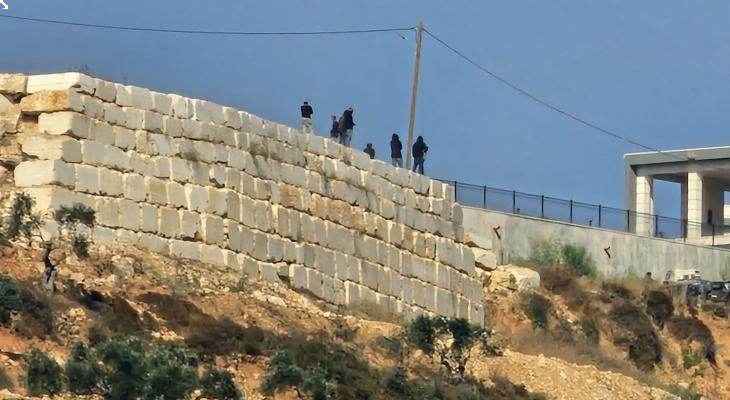
Ramallah, August 12, 2026: The targeting of Palestinian homes on the outskirts of villages is no longer limited to a fleeting attack or a nighttime assault; it has increasingly become a systematic method for imposing a siege, isolating families, and cutting off their means of life, in preparation for pushing them to leave and seizing the location. This is what is happening in the Jabal Ras al-Ayn area in the town of Qusra, south of Nablus, where colonizers are besieging three Palestinian homes in an attempt to turn their temporary presence at the doorsteps of these homes into a permanent colonial outpost.
The direct siege began on Sunday, August 9, 2026, when colonizers set up a tent and temporary structures between homes belonging to the families of Yousef Abdel Salam, Rizq Abu Reda, and Loay Abu Reda. They then blocked the roads leading to the homes with stones, prevented residents from entering or leaving and from receiving visitors, and impeded access to food, water, and medicine, alongside cutting water and electricity lines. The official Wafa news agency reported that attempts to storm and seize the homes began roughly four months earlier, forcing family members to take turns staying in them to prevent them from being left empty.
Inside one of the besieged homes are Qusai Abu Reda, his son Ahmad, and other family members, while the home itself belongs to his brother Loay Abdel Moneim Abu Reda, who resides in the United States and holds American citizenship. During the days of the siege, the family was barred from normal movement and from accessing basic necessities; a Red Crescent ambulance was only able to reach the area once, to evacuate a girl in need of medical care and to bring in a quantity of food, according to Israeli press coverage based on the family's testimony and surveillance camera footage.
International coverage provided independent documentation of the incident. Reuters confirmed that the outpost was established directly in front of three Palestinian homes, and that their residents had effectively become besieged. The agency also reviewed footage showing the confrontation that occurred when the occupation army attempted to dismantle the tent, before withdrawing from the site, after which the colonizers returned to attempt to break down the gate of one of the homes and pelt its surroundings with stones.
A photographer for Agence France-Presse confirmed the colonizers' presence at the site after the forces withdrew, despite the removal of part of the temporary structures. The agency quoted Qusai Abu Reda as saying the family remained deprived of food and medicine, and had relied on solar panels for a limited amount of electricity. Thus, the military intervention did not end the siege; the tent was partially removed, but the colonizers remained at the entrances to the homes, and the restrictions imposed on the families continued.
The occupation army itself acknowledged that the establishment of the outpost and the takeover of homes and land in the area constitutes illegal activity that affects residents and disrupts their daily lives, and declared the location a "closed military zone." However, this acknowledgment of the act's illegality did not translate into actual protection for the families or the complete removal of the colonizers. Rather than reopening the roads and securing residents' access, the evacuation attempt ended with the forces withdrawing and the siege remaining in place, revealing the gap between the stated position and the implementation on the ground.
Targeting the Location Before the Home
The attempt to seize the homes cannot be separated from the geographic importance of Jabal Ras al-Ayn. The area falls within Area B under the Oslo Accords, sits at an elevation of roughly 930 meters above sea level, overlooks a wide expanse, and lies at the center of a number of villages south of Nablus. According to Qusra's mayor, Abdel Azim Wadi, colonizers have attempted to establish a colonial outpost at the site eight times, but residents have thwarted those attempts.
These facts make clear that the homes are not an isolated target, but rather an obstacle to control over a strategically elevated and significant location. The endeavors begins with the erection of a tent, followed by the imposition of a permanent presence around it, the closure of the road, the cutting of services, and the prevention of solidarity and access, eventually culminating in living conditions that become impossible to sustain. Once the family leaves, effective control becomes a launching point for broader colonial expansion.
This model appeared just weeks earlier in the neighboring village of Jalud, when colonizers seized the home of Mahmoud al-Tubasi on July 22, after besieging it for more than three months. According to Wafa, colonizers established an outpost near the home, cut off its electricity, and closed the road to food, water, and medicine, until the family was forced to leave. Invoking the Jalud experience is therefore not a mere comparison, but a warning of the outcome that the siege of Qusra's homes could reach if it is not ended quickly.
The siege of the homes also comes less than two weeks after the burning of the Rahma Mosque, under construction in Qusra, on July 26. The Associated Press documented the attack and the vengeful slogans written on its walls, in the context of escalating colonial attacks on the town.
The Qusra incident reveals a dangerous shift from a swift attack to an extended colonial siege; the goal is no longer to carry out an attack that ends with the assailants' withdrawal, but to create a permanent state of pressure around the home, beginning with the erection of a tent or colonial point adjacent to it, followed by the closure of the road leading to it, the cutting of water and electricity, the prevention of food and medicine from reaching it, and the isolation of the family from its social surroundings. Through these means, the attack shifts from a violent, time-limited act into a daily process of attrition, aimed at making life inside the home impossible and driving its occupants to leave under the weight of fear, isolation, and deprivation. We are facing a method of slow forced displacement that does not begin with a declared eviction order, but with the manufacturing of an expulsive environment in which pressures accumulate until departure becomes an imposed outcome, after which the empty home is presented as space available for control and for establishing a new colonial reality.
The experience of Mahmoud al-Tubasi's family in the village of Jalud offers a complete model of where this path can lead. It began with the establishment of a colonial outpost near the family's home, followed by a siege lasting more than three months, during which the road was closed and electricity cut, and food, water, and medicine were blocked, alongside repeated attacks on the home and its occupants, until the family was forced to leave it, before the colonizers seized it on July 22, 2026. Jalud is therefore not an incident separate from Qusra, but a cautionary precedent that reveals the stages and purpose of the plan: the tent begins near the home, then the colonial presence turns into a siege, the siege into displacement, and the displacement into permanent seizure. From here, protecting the homes of Ras al-Ayn takes on an importance that extends beyond the three families; it represents an early confrontation with an attempt to replicate the Tubasi model, and to turn control over a limited number of homes into a foothold for colonial expansion across the lands of Qusra and its surroundings.
Colonizer attacks are no longer scattered acts or random eruptions of terrorist violence; they have evolved into a system of directed terror that uses integrated tools to target the Palestinian person, their property, and their means of survival in place. These tools include shooting and physical assault; the burning of homes, vehicles, and fields; the uprooting of trees; the theft of or attacks on livestock; the destruction of crops and water networks; and the closure of roads and organized attacks on villages. According to data from the Colonization and Wall Resistance Commission, during the one thousand days from October 7, 2023 to June 30, 2026, colonizers carried out a total of 12,506 attacks, which resulted in the martyrdom of 52 citizens and the ignition of 890 fires affecting citizens' property and fields, figures that reveal arson, shooting, and destruction are no longer incidental means of intimidation, but recurring tools within a broad and organized pattern.
Despite their varying forms, these tools serve a single function: dismantling the conditions for Palestinian survival on the land. Burning fields and crops targets the land and its productivity; stealing livestock strikes at the livelihood of rural and pastoral families; shooting and repeated assaults impose fear and restrict movement; while the destruction of roads and water and electricity networks isolates communities and weakens their capacity for steadfastness. This terror does not stop at inflicting damage, but works to reshape the relationship between the citizen and their place, so that farming becomes fraught with danger, grazing becomes impossible, the road becomes unsafe, and the home itself becomes surrounded by threat. Violence thus becomes a colonial tool whose function is the gradual clearing of Palestinian space, in preparation for filling it with outposts, roads, and zones of colonial control.
The siege of homes represents the most advanced stage in this trajectory, as it combines all the previous tools into an extended process of attrition: encircling the house, closing the road, cutting water and electricity, blocking food and medicine, threatening residents, and establishing a tent or outpost adjacent to them until life becomes impossible. What is happening in Qusra is not separate from the experience of Mahmoud al-Tubasi's family in Jalud, where a siege lasting more than three months, accompanied by repeated attacks, the cutting of services, and the blocking of supplies, ended with the family being forced to leave their home and the colonizers seizing it on July 22, 2026. Thus, the siege of homes does not replace arson, theft, and shooting, but merges them into a more comprehensive formula: the process begins with terrorizing the family, then exhausting its capacity to remain, and ends with turning forced departure into permanent seizure and a new colonial reality.
The incident's gravity is heightened within a broader escalation: the Colonization and Wall Resistance Commission recorded a total of 2,256 attacks carried out by the occupation army and colonizers during July 2026, including 798 attacks carried out by colonizers. Yet the numbers alone do not capture the qualitative shift represented by Qusra: the use of siege, the cutting of services, and road closures as a quiet weapon to displace residents from their land, turning the Palestinian home itself into the first line of confrontation with the project of colonial expansion.
What is happening in Qusra reveals an organized attempt to turn colonizer terror into a tool for displacement and land seizure, while the experience of the Tubasi family in Jalud offers clear evidence of a path that begins with encircling the home and exhausting its inhabitants, then ends with its evacuation, seizure, and the establishment of a new colonial reality. This precedent demands urgent action to protect the besieged families, reopen the roads, restore services, and remove the colonial outpost completely and immediately. The occupying state bears full legal responsibility for the crimes of the colonizers and for the protection and immunity it provides them, while international silence grants the perpetrators wider space to repeat this model. Protecting the homes of Qusra today prevents the replication of the Jalud experience and preserves the Palestinian presence in Jabal Ras al-Ayn; protecting the home here is protection of the land and a direct confrontation with the plan of forced displacement.